
I’ll be honest with you: a lot of what passes for “sustainability” in the events industry is greenwashing. I’ve been in this business for 14 years, and I’ve seen my share of events that called themselves “green” because they swapped plastic water bottles for paper cups — while flying 500 people across the country for a one-day conference that could have been a Zoom call. That’s not sustainability. That’s marketing.
But here’s the thing — and this is why I wanted to write this post — sustainability in events doesn’t have to be performative. There are real, practical things you can do that genuinely reduce your event’s environmental impact. Some of them will even save you money. And none of them require you to sacrifice the quality of your event.
I’m not going to pretend Thalsamaya has been a sustainability champion since day one. We haven’t. Like most event production companies, we were focused on delivering great experiences and didn’t think much about the waste we generated in the process. But over the past few years, especially working with clients like Airbus and other multinational corporations that have serious ESG commitments, we’ve been forced to think about this more carefully. And I’m glad we were, because it’s changed how we approach every event now.
So here’s what I’ve learned about sustainable event practices — the ones that actually work, not the ones that just look good in a press release.
Digital Over Physical: The Easiest Win
Let’s start with the low-hanging fruit. If you’re still printing 500 copies of an event agenda in 2026, I have questions. Specifically: why?
E-tickets, digital agendas, QR code check-ins, and paperless registration — these aren’t futuristic concepts. They’re standard technology that’s been available for years. And yet, I still walk into events where someone hands me a printed welcome kit with a 20-page booklet, a paper name badge in a plastic holder, and a schedule printed on card stock that’ll be outdated by lunch because Session 3 got moved.
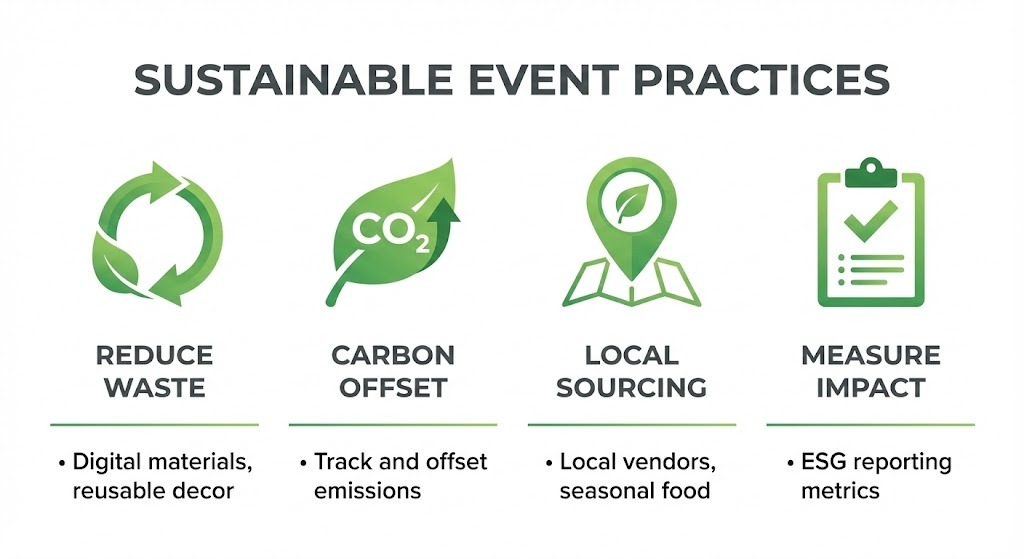
Here’s what we recommend to clients now: a single QR code at the entrance that links to everything — agenda, speaker bios, venue map, feedback forms, Wi-Fi password. One QR code replaces an entire welcome kit. The cost savings are real. For a 500-person event, you’re looking at saving anywhere from ₹50,000 to ₹1.5 lakhs on printed materials alone, depending on how elaborate your kits used to be.
Digital feedback forms instead of paper surveys. Digital business card exchange instead of everyone carrying 50 cards they’ll lose in a drawer. Digital certificates of participation instead of printed ones. Every one of these switches is better for the environment and more convenient for attendees. It’s rare that sustainability and convenience align this perfectly — take the win.
Hybrid Events: The Biggest Carbon Savings Nobody Talks About
I run a live streaming company, so I have an obvious bias here. But the numbers don’t lie: the single biggest source of carbon emissions from any corporate event is travel. Not the venue’s electricity. Not the catering. Not the printed materials. Travel. Specifically, flights.
A single round-trip flight from Bangalore to Delhi generates roughly 300-400 kg of CO2 per passenger. Multiply that by 200 attendees flying in for a two-day conference, and you’re looking at 60-80 tonnes of CO2 just from air travel. For context, the average Indian’s total annual carbon footprint is about 1.9 tonnes. Your two-day conference just generated the equivalent annual emissions of 30-40 people.
Now, I’m not saying every event should be virtual. In-person events have irreplaceable value — the networking, the energy, the human connection. I’d be putting myself out of business if I said otherwise. But hybrid events — where a core group attends in person and a larger group participates remotely via live stream — can dramatically reduce travel emissions while still delivering a meaningful experience.
We’ve done hybrid events where 150 people were in the room and 600 were watching the live stream. Those 600 remote attendees didn’t fly anywhere. They didn’t need hotel rooms. They didn’t generate catering waste. And with good production — multiple camera angles, audience interaction tools, dedicated online moderators — their experience was genuinely engaging. Not the same as being there, but far better than just reading a summary email afterwards.
Venue Selection: It Matters More Than You Think
Where you host your event is one of the most impactful sustainability decisions you’ll make, and it’s one that most organizers don’t think about beyond “does it have enough capacity and is it within budget?”
Increasingly, venues in India — especially in Bangalore, where we do most of our work — are getting sustainability certifications. LEED-certified buildings, venues with solar power, properties that have water recycling systems, spaces that use energy-efficient HVAC. Choosing a venue with these features means your event benefits from their infrastructure investments without you having to do anything extra.
Beyond certifications, think about location. A venue that’s accessible by metro or well-connected by public transport means fewer people driving individual cars. That sounds small, but for a 500-person event, it can meaningfully reduce emissions. We’ve started recommending that clients include public transport information in their event communications and even provide shuttle services from major transit hubs instead of assuming everyone will drive or take cabs.
Also — and this is practical rather than glamorous — choose a venue that’s the right size for your event. An oversized venue wastes energy on heating, cooling, and lighting space that nobody’s using. I’ve seen companies book a 1,000-person ballroom for a 200-person event because they wanted it to “feel grand.” It didn’t feel grand. It felt empty. And it consumed five times the energy it needed to.
Catering: Where Waste Gets Real
If sustainability in events has a villain, it’s food waste. The numbers are genuinely uncomfortable. Industry estimates suggest that 15-20% of food prepared for corporate events goes uneaten. For a large conference with elaborate catering, that can mean hundreds of kilograms of food heading straight to the bin.
Here’s what we’ve seen work:
Accurate headcounts with buffer management. This sounds obvious, but the standard practice in Indian catering is to prepare for 15-20% more people than confirmed. Sometimes that’s necessary. Often it’s just habit. Working with your caterer to tighten that buffer based on historical attendance data can significantly reduce waste.
Local sourcing. Food that travels less has a smaller footprint. And honestly, it usually tastes better. We’ve worked with caterers in Bangalore who source primarily from farms within 100 km of the city, and the quality difference is noticeable. Your attendees won’t know they’re eating “sustainable” food — they’ll just know it’s fresh.
Plant-forward menus. I’m not saying make your entire event vegan — that’s a quick way to get angry attendees in India, where food preferences are deeply personal. But shifting the ratio so that plant-based options are prominent rather than an afterthought makes a real difference. The carbon footprint of a vegetarian meal is roughly 50-60% lower than a non-vegetarian equivalent. And in India, we’re fortunate that our culinary tradition already has an incredibly rich vegetarian repertoire. Use it.
Partnerships with food rescue organizations. Several cities, including Bangalore, now have organizations that will collect surplus food from events and distribute it to people in need. We’ve helped clients connect with these services, and it transforms food waste from a guilt-inducing problem into something that actually does good. It takes about one phone call to set up.
Technology’s Sustainability Role
Beyond live streaming for hybrid events, technology offers some genuinely useful sustainability tools that we’ve started incorporating:
Digital swag bags. Physical goodie bags are — let’s be honest — mostly junk. Branded pens that stop working after a week. Notepads that go into a drawer. Stress balls shaped like your company logo. Most of it ends up in the trash. Digital swag — app subscriptions, online course access, digital gift cards, exclusive content — is cheaper, generates zero physical waste, and is often more valued by recipients. We’ve had clients report higher attendee satisfaction after switching to digital swag. People actually want a free month of Audible more than they want another tote bag.
AI-powered scheduling. This is newer, but I find it fascinating. AI tools can now optimize event schedules to reduce idle time — those gaps between sessions where the venue is lit, air-conditioned, and staffed but nothing’s happening. Tighter scheduling means shorter overall event duration, which means less energy consumption. It also means fewer hours that attendees need to be away from home, which can reduce hotel stays.
Virtual networking platforms. These supplement in-person networking and can reduce the need for multiple in-person events. If your company runs quarterly meetups, could two of them be virtual and two be in-person? That’s a 50% reduction in event-related travel right there.
Measuring Impact: You Can’t Improve What You Don’t Measure
Here’s where most “sustainable events” fall apart. They implement a few green practices, pat themselves on the back, and never actually measure whether they made a difference. That’s not sustainability — that’s vibes.
Actually calculating your event’s carbon footprint isn’t as complicated as it sounds. There are now several online calculators designed specifically for events. They factor in travel, venue energy, catering, materials, and waste. The first time you run the numbers, you might be surprised — or horrified — by the results. But that baseline is essential. Without it, you’re just guessing.
We’ve started offering clients a basic sustainability report after events we produce. It’s not a full life-cycle analysis — we’re a production company, not environmental consultants — but it tracks the key metrics: estimated travel emissions saved through hybrid participation, paper saved through digital materials, food waste reduced through better catering management. Having numbers turns sustainability from a vague aspiration into a concrete, improvable metric.
Client Expectations Are Changing — Fast
If you’re thinking “this all sounds nice, but my clients don’t care about sustainability,” I’d gently suggest that’s changing faster than you might expect. Especially in the Indian corporate world.
ESG compliance — Environmental, Social, and Governance reporting — is no longer optional for many large companies. And that compliance extends to their events. We’ve had procurement teams from multinational clients ask us for our sustainability practices before signing contracts. Two years ago, that never happened. Now it’s becoming routine.
SEBI’s Business Responsibility and Sustainability Reporting (BRSR) requirements for the top 1,000 listed companies mean that sustainability data is being tracked at a granular level. Events that generate significant waste or emissions can become a reporting liability. Companies that can demonstrate sustainable event practices have a genuine competitive advantage — not just a moral one.
I’ve watched this shift happen in real time. Five years ago, when I’d mention sustainability options to a client, they’d say “nice, but what does it cost?” Now they ask, “what’s your sustainability approach?” before we even get to pricing. That’s a fundamental change.
The Money Question: Sustainable Is Often Cheaper
This is my favourite part of the sustainability conversation, because it surprises people. Many sustainable practices actually reduce costs.
Digital materials instead of printed kits? Cheaper. Tighter food ordering based on actual attendance data? Cheaper. Right-sized venues? Cheaper. Hybrid events that reduce the number of people you need to fly in and accommodate? Significantly cheaper. LED lighting instead of traditional stage lighting? Uses less electricity, runs cooler (which means less air conditioning), and looks better.
There are areas where sustainability does cost more — organic and locally sourced catering can carry a premium, proper waste management and recycling requires effort and sometimes additional vendors, and carbon offset programmes have a direct cost. But in our experience, the savings from other sustainable practices usually outweigh these additional costs. For most events, going greener is either cost-neutral or actually saves money.
That’s a much easier conversation to have with budget-conscious clients than “it’ll cost more, but it’s the right thing to do.”
Real Talk: What We’ve Done (and What We Haven’t)
I want to be transparent here because I think credibility matters more than marketing. At Thalsamaya, we’ve made real progress on sustainability, but we’re far from perfect.
What we’ve done well: we’ve moved almost entirely to digital workflows — digital call sheets, digital run-of-show documents, digital invoicing. Our live streaming services inherently support hybrid events that reduce travel. We’ve invested in energy-efficient LED lighting equipment that’s replaced most of our older, power-hungry fixtures. We actively recommend sustainable practices to clients and include them in our proposals.
What we’re still working on: we still generate equipment packaging waste that we haven’t fully solved. Our own team travels to events by road, and while we try to consolidate trips, there’s only so much you can do when you need to be on-site with gear. We don’t yet have a formal carbon offset programme, though we’re exploring it.
I share this because I think the events industry needs more honesty about where we are. Pretending we’ve solved sustainability doesn’t help anyone. Acknowledging we’re on a journey and sharing what’s working — that’s actually useful.
The Honest Truth
Perfect sustainability in events isn’t achievable yet. Not in India, not anywhere. Events inherently involve resource consumption — energy, materials, food, travel. The goal isn’t perfection. The goal is consistent, measurable improvement.
If your last event generated 100 kg of paper waste and your next one generates 20 kg, that’s an 80% reduction. That matters. If your last conference flew in 300 people and your next one flies in 150 while streaming to the other 150, you’ve halved your travel emissions. That matters too.
Don’t let the perfect be the enemy of the good. Start with the easy wins — digital materials, right-sized catering, hybrid options. Build from there. Measure your progress. And be honest about what you’re doing and what you’re not.
The events industry will get to genuine sustainability eventually. It’ll happen because clients demand it, because regulations require it, and because — honestly — it just makes economic sense. The companies that figure this out early will have a real advantage. I’d rather Thalsamaya be one of them, and I’d rather our clients be too.
If you’re planning an event and want to explore how to make it more sustainable without sacrificing quality, we’d love to help. We’ve been figuring this out through trial and error for the past few years, and we’re happy to share what we’ve learned. Reach out at +91 96635 06306 or sales@thalsamaya.com. Let’s make your next event one that’s worth remembering — and worth repeating.