
When COVID hit, everyone scrambled to figure out virtual events. Zoom fatigue became a real thing. Then, as offices reopened, a question emerged: do we go back to in-person, or have we learned something valuable about reaching people who can’t travel?
The answer, for most organisations, is both. Hybrid events aren’t a compromise — they’re an evolution.
What We Mean by Hybrid
Let’s clear something up. Pointing a camera at your conference and streaming it isn’t a hybrid event. That’s a live stream with an audience. A true hybrid event treats both audiences — in-person and remote — as first-class participants.
That means remote attendees can ask questions, participate in polls, network with people in the room, and feel genuinely included. It’s harder to pull off, but the results are worth it.
I think of it this way: if your remote attendees could unplug and feel like they didn’t miss anything important, you’ve built a real hybrid event. If they feel like they watched a live stream while the “real” event happened somewhere else, you’ve just streamed a conference.
Why Indian Companies Are Going Hybrid
India is a big country. Getting everyone to Bangalore or Mumbai for a two-day conference isn’t just expensive — it’s often impossible. Hybrid events let you include your team in Chennai, your distributors in Kolkata, and your partners in Delhi without asking everyone to book flights.
We did an annual dealer meet for a manufacturing company last year. In previous years, they’d fly 200 dealers to Bangalore, put them up in hotels for two nights, and run a full day of presentations and workshops. Total cost: well over a crore. With a hybrid format, 80 key dealers attended in person and another 350 joined virtually. The content was the same. The interaction was the same. The cost was about 40% less. And they reached nearly three times the audience.
There’s also the sustainability angle. Fewer flights, fewer hotel rooms, smaller carbon footprint. Some organisations now track this as part of their ESG reporting. It’s not the primary driver for most companies, but it’s a nice bonus that plays well in annual reports.
Budget Planning for Hybrid Events
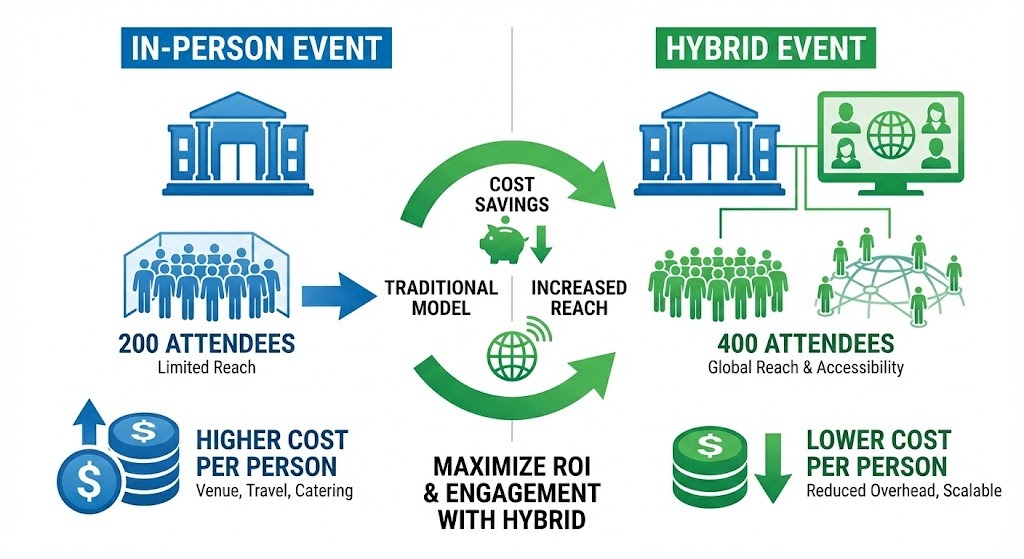
Let me be upfront: hybrid events don’t cost less than in-person events. They cost differently. You save on some things and spend on others.
Here’s the rough breakdown. A purely in-person event for 200 people might cost X. The same event as hybrid — 100 in-person and 300 virtual — will cost roughly 1.2X to 1.5X. You’re spending less on venue, catering, and travel (fewer in-person attendees), but more on technology, production, and platform costs.
The key insight is cost per attendee. If your in-person event costs 10 lakhs for 200 people, that’s 5,000 per person. A hybrid event at 13 lakhs for 400 people (100 in-person, 300 virtual) drops to 3,250 per person. Your total spend is higher, but your reach and per-person cost are both better. That’s usually the number that convinces finance teams.
Where the money goes in hybrid: roughly 40% on in-person logistics (venue, catering, travel for key attendees), 35% on production and technology (cameras, streaming, platform, crew), 15% on content development (designing for both audiences), and 10% on contingency. That last bucket is important — hybrid events have more moving parts, and something will always need a last-minute fix.
Choosing the Right Venue
Not every venue works for hybrid. We’ve learned this through painful experience. Beautiful heritage properties with stone walls that block WiFi. Convention centres with lighting that makes everyone look slightly green on camera. Ballrooms where the acoustics turn every speaker into an echo chamber.
What to look for: robust internet infrastructure (not just “we have WiFi” — ask for dedicated bandwidth and get the numbers in writing), proper AV capabilities, and a layout that works for cameras without blocking sightlines for in-person attendees.
A specific thing we check: is there a room adjacent to the main hall that we can use as a production control room? Running cables across a ballroom floor is messy and dangerous. Having a dedicated space for our switching equipment, streaming systems, and technical crew makes everything run smoother. Most good venues have this, but you need to ask.
Also, check the power situation. We run a lot of equipment — cameras, encoders, monitors, networking gear, computers. We need clean, reliable power with enough capacity. I’ve been to venues where plugging in our equipment tripped a breaker that took out the house lights. Not ideal.
The Technology Stack
This is where it gets complicated. You need a platform that handles the virtual experience, equipment that captures the in-person event properly, and systems that let both audiences interact.
We’ve worked with most major platforms, and here’s our honest assessment for the Indian market:
Zoom Events is the safe choice. Everyone knows how to use Zoom. The learning curve is zero. For internal events — town halls, training sessions, team meetings — it’s hard to beat. The downside is it feels like a Zoom call, which can undermine the “special event” feeling you’re going for.
Airmeet is an Indian platform that understands the local market well. Good for networking-heavy events, conferences with multiple tracks, and situations where you want the virtual experience to feel different from a video call. Their “lounge” and “table” features for virtual networking are genuinely clever.
Hopin offers a comprehensive event platform with expo areas, networking, and multi-stage support. Good for large conferences with exhibitions. The learning curve is steeper for both organisers and attendees.
YouTube Live or custom RTMP — for events where you just need a large number of people to watch without heavy interactivity, a private YouTube stream or custom streaming page works well and costs very little. We combine this with separate tools for Q&A and polling when needed. It’s not elegant, but it’s reliable and scales to any audience size.
Our advice: don’t choose a platform based on feature lists. Choose based on what your specific audience can actually use. If your virtual attendees are dealers in tier-2 cities accessing on mobile, platform simplicity trumps feature richness every time.
Designing for Both Audiences
Here’s the trap most people fall into: they design a great in-person event and then try to stream it. Remote attendees can tell they’re an afterthought. They see the backs of heads. They miss the sidebar conversations. They feel like they’re watching through a window.
Good hybrid design starts with both audiences in mind. Speakers address cameras as well as the room. Q&A pulls from both virtual and in-person attendees. Networking sessions mix people deliberately.
A technique that works well: assign a “virtual host.” This is a person whose entire job is to represent the remote audience. They’re on stage (or near it), they relay questions from the chat, they give the remote audience a voice in the room. It sounds like a small thing. It’s not. Remote attendees go from feeling like observers to feeling like they have an advocate in the room.
Timing is different for virtual audiences too. In-person attendees get coffee breaks, hallway conversations, buffet lunches — natural mental breaks. Virtual attendees sitting at their desks don’t get these. Build in explicit breaks for the virtual audience. Ten minutes every hour, minimum. And consider making virtual sessions slightly shorter than in-person ones.
The Production Team
Hybrid events need more crew than purely physical or virtual events. Someone managing the virtual platform. Someone directing cameras. Someone moderating chat. Someone coordinating speakers. Someone monitoring the stream quality in real time.
This isn’t where you cut corners. Understaffing a hybrid event leads to one audience or the other feeling neglected. For a full-day hybrid event with 100+ virtual attendees, our typical crew is eight to ten people. That includes camera operators, a vision mixer, an audio engineer, a stream engineer, a virtual platform manager, a floor director, and one or two production assistants.
Can you do it with fewer? Sure. But something will suffer. Usually it’s the virtual experience, because the in-person problems are visible and get fixed immediately while virtual issues go unnoticed until someone complains in the chat.
Indian Market Specifics
Running hybrid events in India has some unique challenges that you won’t find in most “how to plan a hybrid event” guides written for Western markets.
Connectivity in tier-2 and tier-3 cities. If your virtual audience includes people in Lucknow, Coimbatore, Indore, or similar cities, don’t assume they have reliable broadband. Mobile data is often their primary connection, and bandwidth can be inconsistent. Design your stream for this reality — offer a low-bandwidth viewing option, keep graphics simple and high-contrast, and make sure your platform works well on mobile browsers.
Regional language considerations. India’s linguistic diversity is a real factor. We’ve done events where the main presentations were in English but the Q&A needed to accommodate Hindi, Tamil, and Kannada. Solutions range from simple (a multilingual moderator who translates questions) to sophisticated (real-time interpretation channels). The right approach depends on your audience.
Payment and platform access. Some international event platforms have payment or access friction for Indian users — UPI integration might be missing, or the platform might be blocked on certain corporate networks. Always test the registration and access flow from an Indian user’s perspective before committing to a platform.
Common Mistakes to Avoid
After doing this for years, we’ve seen the same mistakes repeated. Here’s what to watch for:
Testing the virtual experience last. Most organisers obsess over the in-person setup and test the virtual side as an afterthought. Flip that. Test the virtual experience first, because your remote attendees have even less tolerance for glitches — they’re one click away from their email inbox.
Ignoring the chat. If you offer a chat feature for virtual attendees and then nobody responds to their messages, you’ve actually created a worse experience than not having chat at all. Assign someone to actively engage in the chat throughout the event.
Not having a Plan B for the stream. We’ve had events where the primary streaming setup had issues and we switched to backup within seconds because we’d planned for it. Always have a backup streaming path. Always.
Treating virtual attendees as spectators. This is the big one. If your remote audience can’t ask questions, vote in polls, or interact with speakers, they’re not attending your event. They’re watching a video. And they know the difference.
Measuring Success
How do you know if your hybrid event worked? You need different KPIs for each audience.
For in-person attendees: standard event metrics — attendance rate, session ratings, networking connections made, post-event survey scores.
For virtual attendees: average watch time (not just registrations — how long did people actually stay?), engagement rate (what percentage participated in polls, Q&A, or chat?), drop-off points (when did people leave?), and content consumption (did they watch on-demand recordings afterward?).
For the business: total reach (combined attendance), cost per attendee, leads generated (if applicable), and NPS scores broken down by in-person versus virtual.
The metric most people forget: would virtual attendees attend virtually again? If they say “this was great, I’d do this again,” you’ve built something sustainable.
Rehearsals Save Events
Every hybrid event disaster we’ve witnessed came down to inadequate preparation. The speaker who didn’t know where to look. The poll that didn’t launch. The breakout room that nobody could join. The audio from the room that was unintelligible for virtual attendees.
Full technical rehearsals aren’t optional. Test everything with real people, in the actual venue, with the real equipment. Have someone join from home as a virtual attendee and report back honestly on the experience. Problems are much cheaper to solve the day before than during the live event.
Let’s Plan Your Hybrid Event
We’ve been producing hybrid events since before they had a name. Happy to chat about what you’re planning and share what we’ve learned along the way.
Contact us at +91 96635 06306 or sales@thalsamaya.com.