The finance director looked skeptical. “Three lakhs for a video? How do we know it’s worth it?”
Fair question. Marketing teams often struggle to justify video production budgets because the returns aren’t always obvious. But after producing hundreds of corporate videos, we’ve seen clear patterns in what drives ROI — and the numbers are more compelling than most people expect.
The Numbers That Matter
Let me share some data points we’ve seen play out repeatedly, both in industry research and in our own clients’ results.
Video on landing pages increases conversions by up to 80%. That’s not our number — that’s from multiple studies across industries. But we’ve seen it firsthand. A SaaS client added a 90-second product video to their homepage. Conversion rate went from 2.1% to 3.6%. On their traffic volumes, that translated to roughly 40 additional qualified leads per month. At their average deal size, the video paid for itself in the first week.
Including video in email increases click-through rates by 200-300%. One of our clients in the education space started embedding video thumbnails in their nurture emails. Open rates stayed the same, but click-throughs tripled. People who won’t read a paragraph will click play on a video.
Social media posts with video get 48% more views than those without. Viewers retain 95% of a message when watching video, compared to 10% when reading text. And 84% of people say they’ve been convinced to buy a product or service by watching a brand’s video.
Types of Corporate Videos and Their ROI
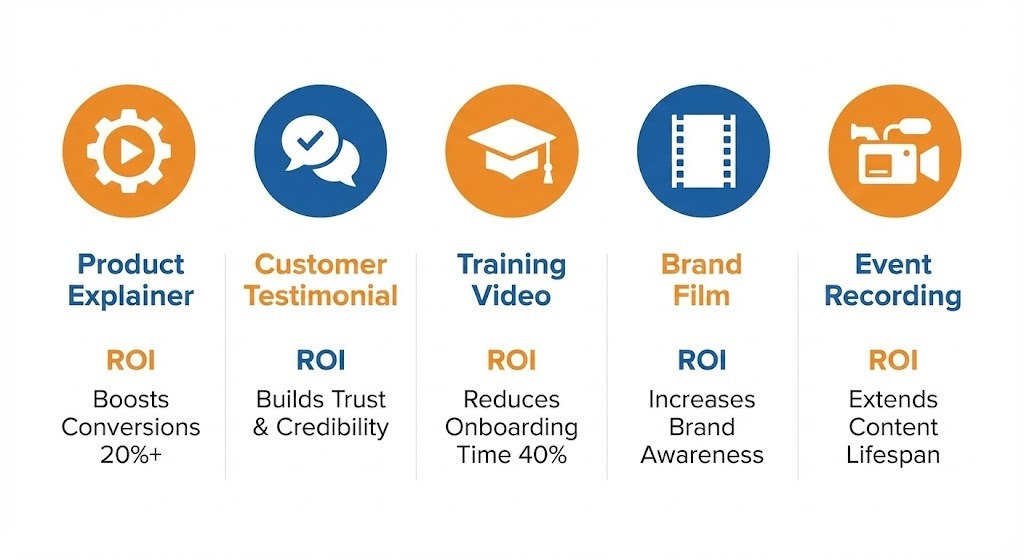
Not all videos are created equal when it comes to return on investment. Here’s a breakdown by type, based on what we’ve seen over the years.
Product explainers earn their keep fast. We produced a two-minute explainer for a B2B software company. They put it on their homepage and in sales emails. Conversion rates jumped. Sales cycles shortened because prospects arrived to calls already understanding the product. That single video influenced crores in revenue over two years. Explainers typically have the clearest, most measurable ROI because they sit at the bottom of the funnel where purchase decisions happen.
Customer testimonials are undervalued. Written case studies get skimmed. Video testimonials get watched. More importantly, they get believed. There’s something about seeing a real person — not an actor, not a stock photo with a quote — talk about their experience that creates trust in a way text simply can’t. We’ve seen testimonial videos shared internally by sales teams more than any other content type.
Training videos scale in ways in-person training can’t. Calculate what you spend on trainers, travel, and venue hire for repeated training sessions. Now imagine replacing half of that with well-produced videos that employees can watch anytime, rewatch when they need a refresher, and access from any location. We did the maths for a client with 2,000 employees across 15 locations. They were spending 18 lakhs a year on recurring in-person safety training. We produced a comprehensive video training series for 6 lakhs. It paid for itself in four months and has been used for three years running with minor updates.
Brand films are the hardest to measure but often the most valuable. A well-crafted brand film shapes perception over years. One of our clients, a mid-sized manufacturing company, invested in a brand film that told their 30-year story. They use it in every investor presentation, every major client pitch, every recruitment conversation. The CEO told me it’s the single most useful piece of marketing they’ve ever produced.
Event recordings and live stream archives are the sleeper hit. You’ve already paid for the event. Recording it and making it available on-demand extends its value enormously. We’ve seen event recordings accumulate views for months after the event — sometimes reaching two to three times the live audience. The marginal cost of recording when you’re already set up for an event is minimal.
Internal vs External Videos
Most conversations about video ROI focus on external, customer-facing content. But some of the highest-ROI videos we produce never leave the company.
Leadership communications. The CEO sends a quarterly email that nobody reads. We helped one client switch to quarterly video messages from leadership. View rates went from an estimated 15% (email opens) to 72% (tracked video plays). Employees felt more connected to leadership. Internal survey scores on “communication from management” improved measurably.
Onboarding videos. New employee onboarding is repetitive by nature — the same presentations, the same walkthroughs, the same introductions, delivered every time someone joins. Video doesn’t replace the human elements of onboarding, but it handles the repetitive parts consistently and frees up managers’ time. One client estimated they saved 15 hours of manager time per new hire by moving standard onboarding content to video. At 50 new hires a year, that’s 750 hours.
Process documentation. This is unglamorous but incredibly practical. How do you reset the production line? How do you file an expense report in the new system? How do you use the CRM properly? Text documentation gets ignored. Video walkthroughs get watched. We’ve produced process videos that reduced support tickets to IT departments by 30-40%.
The Indian Market Context
If you’re making video for an Indian audience — whether customers, employees, or partners — there are some market-specific factors that affect ROI.
India is a mobile-first video market. Over 80% of video consumption in India happens on mobile devices. This has real implications for production. Your videos need to look good on a 6-inch screen. Text needs to be larger. Visual details need to be bolder. And increasingly, videos need to work without sound — subtitles and on-screen text aren’t optional, they’re essential. We’ve had clients whose video engagement doubled simply by adding Hindi and English subtitles.
Video consumption is massive and growing. Indians watch more online video per capita than almost any other market. The average Indian smartphone user watches over 15 hours of online video per week. Your audience isn’t resistant to video — they’re hungry for it.
Multilingual content multiplies reach. India has 22 official languages and hundreds of millions of people who prefer consuming content in their regional language. The same content dubbed or subtitled in regional languages can double or triple your effective reach. The additional cost of dubbing is typically 15-25% of the original production cost — a fraction of the increase in reach it provides.
The Hidden Returns
Some video ROI doesn’t show up in spreadsheets. A strong brand film shapes how people perceive your company. Recruitment videos attract better candidates — we’ve had HR teams tell us their quality of applicants improved after publishing culture and workplace videos, because candidates self-select based on whether the culture looks like a fit.
There’s also the compounding effect. A single video might not move the needle. But a consistent video presence — monthly thought leadership, quarterly product updates, regular customer stories — builds a library that compounds over time. Each video makes the next one more effective because your audience already knows and trusts the format.
Common Mistakes That Kill ROI
No distribution plan. This is the biggest one. A brilliant video nobody sees has zero ROI. Plan distribution before production. Where will this live? How will people find it? A rough rule of thumb: spend at least as much on distribution as you do on production.
Trying to do too much in one video. “Can we also mention our new product? And our upcoming event? And our CSR initiative?” No. The highest-performing videos we’ve produced had a single, clear purpose. One message. One audience. One call to action.
Ignoring the first five seconds. On social media, you have about five seconds before someone scrolls past. If your video opens with a logo animation, a fade from black, and a sweeping aerial shot of your office building, you’ve lost half your audience before saying anything meaningful. Hook first. Brand later.
Not updating outdated videos. A product demo from three versions ago. A testimonial from a client who’s since left for a competitor. Outdated videos don’t just fail to generate ROI — they actively harm your credibility. Audit your video library annually.
What Determines ROI
The same budget can produce very different results depending on how it’s spent.
Clear objectives matter. Before we start any project, we ask: what does success look like for this video? If the answer is vague — “we want more brand awareness” — we push for specifics. The clearer the objective, the better we can optimise the video to achieve it.
Distribution matters. Plan distribution before production. Where will this live? How will people find it? What’s the promotion strategy?
Production quality matters, to a point. Amateur video reflects poorly on your brand. But there’s a threshold beyond which additional production spend doesn’t improve results. Know where that threshold is for your audience.
Making the Business Case
When justifying video investment, think about:
Lifespan analysis. How long will this video be useful? A product demo might be outdated in a year. A brand film might work for five. Divide the cost by the lifespan.
Funnel position. Where does this video fit in your customer journey? Videos that influence purchase decisions have clearer ROI than awareness videos. Both have value — but the value looks different. If you need to show quick returns, start with bottom-of-funnel videos.
Replacement cost analysis. What would you spend instead? Compare video costs to alternatives. Trade show booths, print advertising, in-person training. Video often looks economical in comparison.
The “do nothing” cost. What’s the cost of not having video? Your competitors have product videos and you don’t — how many prospects chose them because their product was easier to understand? Sometimes the strongest business case isn’t about the return video generates, but about the cost of its absence.
Let’s Discuss Your Project
Not every video makes sense for every company. Sometimes the answer is “not right now” or “start smaller.” We’re happy to give honest advice about whether a video project makes sense for your situation.
Get in touch: +91 96635 06306 or sales@thalsamaya.com.