The best product launch I ever witnessed wasn’t the most expensive or the most technically sophisticated. It was a smartphone launch in Chennai where the founder told the story of why he started the company while his grandmother sat in the front row. By the time he unveiled the product, half the room was emotional.
That’s what a launch should do. Not just announce a product, but make people care about it.
I’ve been producing product launches for over fourteen years now — automotive unveilings, tech releases, FMCG rollouts, pharma introductions. The budgets vary wildly, the industries couldn’t be more different, but the launches that actually work all share the same DNA. Here’s what we’ve learned.
Starting with Story
Every product has a story. The problem it solves. The people who built it. The moment someone realised it needed to exist. Too many launches skip straight to specifications and features. They forget that people buy stories, not spec sheets.
Find your story before you plan anything else. The venue, the production, the guest list — all of that should serve the story you’re telling.
I remember a medical device launch where the company initially wanted to lead with the technical specifications — processor speed, sensor accuracy, battery life. We pushed them to instead open with a video of the doctor who inspired the product, talking about patients she couldn’t help with existing tools. By the time the CEO walked on stage and revealed the device, the specifications weren’t just numbers. They were solutions to a problem the audience now understood viscerally.
The story doesn’t have to be dramatic. Sometimes it’s as simple as “our engineers were frustrated that this problem didn’t have a good solution, so they built one.” Authenticity beats drama every time.
Types of Product Launches
Not all launches are the same, and treating them identically is a mistake we see constantly.
Automotive launches are the big productions. The audience expects spectacle — dramatic reveals, cinematic lighting, an experience that matches the premium positioning of the vehicle. We’ve done launches where the car literally descended from the ceiling on a custom platform. But here’s the thing: even with all that production, the test drive zone afterwards is where buying decisions actually happen. Don’t spend your entire budget on the stage and neglect the hands-on experience.
Tech product launches are increasingly about community. The old model of a press conference with journalists in rows is dying. Today’s tech launches work best when they feel like events the audience wants to attend. Live demos matter enormously — and they’re terrifying, because live demos can fail. Always have a backup plan. We run every live demo at least ten times before the event, and we still keep a pre-recorded version ready.
FMCG launches are about sensory experience. If you’re launching a food product, people need to taste it. A fragrance? They need to smell it. Keep the stage portion short and get products into hands fast.
Pharma launches operate under regulatory constraints that change everything. You can’t make certain claims, you need specific disclaimers, and your audience is often sceptical doctors who’ve seen a hundred product pitches. What works in pharma is credible data, respected KOLs, and enough respect for the audience’s intelligence to present evidence rather than hype.
The Reveal Moment
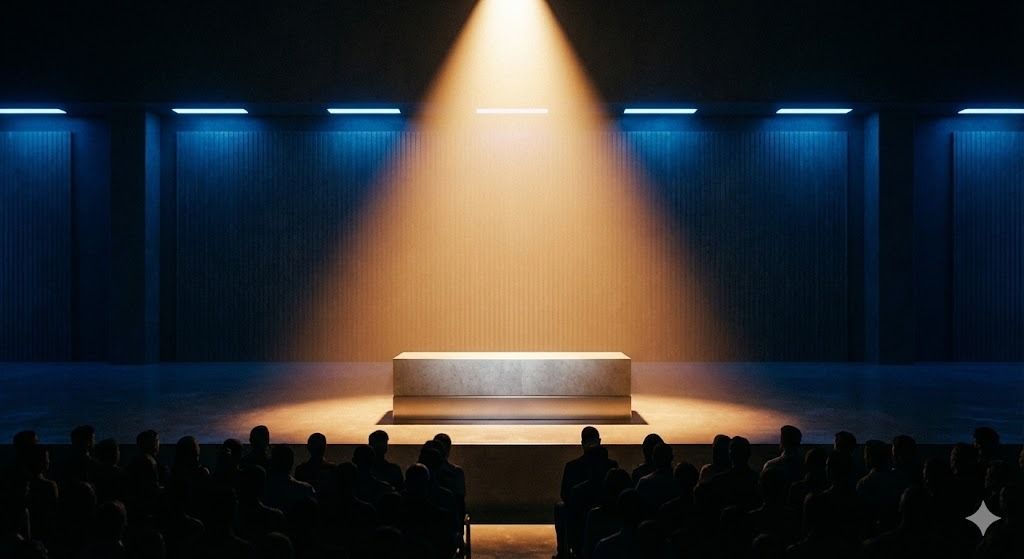
There’s a reason Apple spent years perfecting the moment when Steve Jobs pulled a product from his pocket. The reveal is the climax of your launch narrative. Everything builds to it, and everything after references it.
We’ve done dramatic unveils with custom-built reveal mechanisms, smoke, and lighting. We’ve also done quiet, intimate moments where the CEO simply removed a cloth covering. Both worked because they matched the brand and the story.
A few principles for the reveal:
Build anticipation. The reveal should come after the audience wants it, not before. We usually aim for the reveal to happen around the 15-20 minute mark of the main presentation.
Make it visual. The reveal moment needs to photograph well and look good on video. This is the image that will appear in media coverage, on social media, in recap videos.
Have a reaction shot. We always position a camera on the audience during the reveal. Genuine audience reactions — gasps, applause, leaning forward — are powerful content for post-event marketing.
Venue Sets the Tone
A luxury car brand launching in a converted warehouse sends a different message than launching in a five-star hotel ballroom. Neither is wrong — but they’re saying different things.
We’ve used industrial spaces, heritage properties, rooftops, even airport hangars. The unconventional venues tend to generate more buzz, but they also require more production work to get right.
Practical considerations that get overlooked: power supply (unconventional venues often can’t handle the electrical load without generators), parking (your guests’ experience starts in the car park, not at the door), and accessibility (heritage buildings with narrow staircases aren’t ideal when you have 300 guests arriving simultaneously).
Technology as Enhancement
AR, VR, projection mapping, drone shows — the options are endless. But technology should enhance your launch, not become it. The worst launches we’ve seen were so focused on technical wizardry that the product got lost.
Use technology when it serves the story. Skip it when it doesn’t.
That said, some technology genuinely elevates launches. Projection mapping onto a building facade for an evening launch creates an unforgettable experience. AR that lets attendees see inside a product — the engine of a car, the components of a device — adds genuine value beyond spectacle. Interactive touchscreens in experience zones let attendees explore features at their own pace.
The test is simple: does this technology help people understand or appreciate the product better? If yes, use it. If it’s just cool for cool’s sake, save the budget.
Digital and Social Media Integration
Your launch doesn’t exist if it doesn’t exist online. That sounds dramatic, but it’s essentially true in 2026.
Before the event: Build anticipation with teaser content. Countdown posts, behind-the-scenes glimpses of preparation, cryptic hints about the product. Create a launch-specific hashtag and start using it weeks before the event.
During the event: A live social wall displaying tweets and Instagram posts creates a feedback loop — attendees see their posts on screen, which encourages more posting. We set up dedicated social media stations with good lighting and branded backdrops.
Influencer seating matters. Don’t scatter your influencers randomly. Seat them where they’ll have the best angles for content creation. Give them early access to the product so they can post hands-on content while the event is still happening.
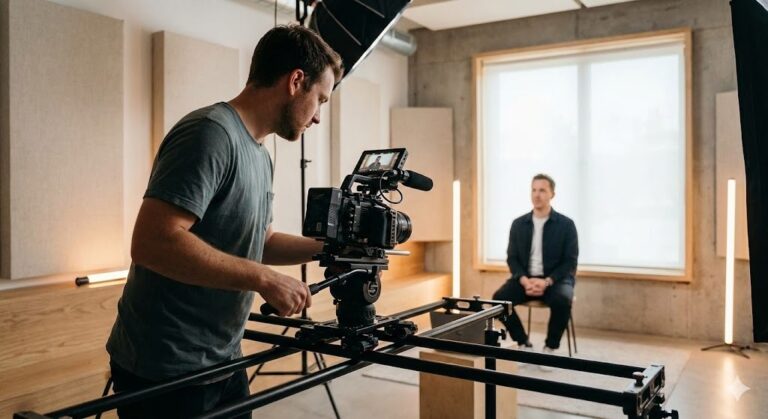
Live streaming the launch extends your audience beyond the room. But don’t just point a camera at the stage. Produce the stream as its own experience — add graphics, switch between cameras, have a stream-specific host who addresses the online audience directly.
After the event: Have your content team editing highlight reels that same evening. The first 24 hours after a launch are when media interest peaks.
Hands-On Matters
For physical products, people need to touch, feel, and experience. Build zones where attendees can interact with the product properly. Not a quick glance behind a rope line — genuine hands-on time with knowledgeable staff.
These interaction zones often generate more word-of-mouth than the main stage presentation.
Design the flow deliberately. After the main presentation ends on a high note, guide attendees naturally into the experience zone. Have enough product units that people aren’t queuing for twenty minutes. Staff these zones with people who genuinely know the product.
Timeline and Planning
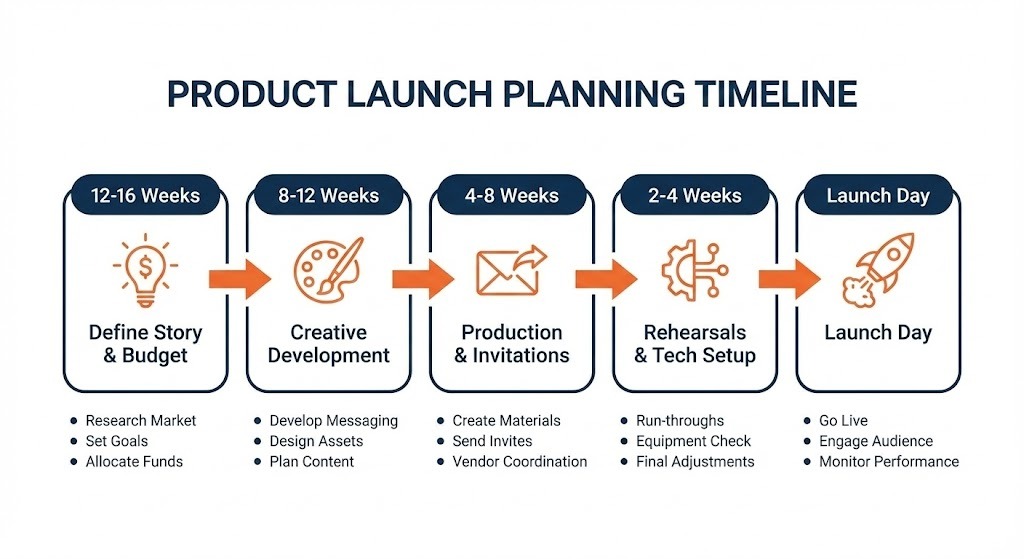
The biggest launch planning mistake? Starting too late. Here’s a realistic timeline for a major product launch:
12-16 weeks out: Define objectives, story, and key messages. Begin venue scouting. Set the budget. Identify your production partner.
8-12 weeks out: Finalise venue. Begin creative development — stage design, graphics, video content. Start building your invitation list.
4-8 weeks out: Production design finalised. Speaker coaching begins. Send invitations. Finalise technology elements.
2-4 weeks out: Technical site survey at the venue. Begin building your run sheet — minute by minute. First rehearsal with speakers.
1 week out: Full technical rehearsal at the venue. Final speaker rehearsal. Test all technology. Brief all staff.
Day before: Full load-in and setup. Complete technical check. Final walkthrough. Rest.
Measuring Launch Success
Too many companies throw a spectacular launch and then have no way to measure whether it actually worked. Define your success metrics before the event.
Media coverage: How many outlets covered the launch? What was the reach? Was the coverage positive?
Social media metrics: Hashtag usage, mentions, share of voice compared to competitors, sentiment analysis.
Lead generation: For B2B launches, how many qualified leads came from the event? Track these leads through your CRM to eventual conversion.
Content performance: How did your launch content perform over the following weeks? Views, engagement, shares.
Extending Beyond the Room
Your launch audience isn’t just who’s in the venue. It’s everyone watching online, everyone who’ll see the coverage later, everyone who’ll hear about it from someone who was there.
Plan for content creation from the start. Highlight reels, social media clips, behind-the-scenes footage. The launch event itself might last two hours. The content can work for months.
Let’s Create Something Memorable
We’ve done automotive unveilings, tech product launches, fashion shows, and everything in between. Every launch is different, but the fundamentals remain: tell a great story, create a memorable moment, and make people care.
If you’re planning a launch, talk to us early. The best launches aren’t just produced well — they’re planned well, from the very first conversation about what the product means and who needs to hear about it.
Reach out: +91 96635 06306 or sales@thalsamaya.com.