
A client called us last month in a panic. They’d signed up for a virtual event platform based on a sales demo, and now — two weeks before their annual conference — they’d discovered it couldn’t do half of what they needed. They’d chosen based on marketing promises rather than real requirements.
This happens more often than you’d think. I’ve been in this industry for over fourteen years, and the number of times a company has come to us mid-crisis because their platform can’t deliver is honestly embarrassing — for the platform vendors, not for us. Here’s how to choose a platform that actually fits.
Starting with What You Actually Need
Before comparing features, get clear on your event. How many attendees? What kind of interaction do you need? Is networking important, or is this primarily a broadcast? Do you need breakout rooms? Exhibition booths? Registration and ticketing?
A platform that’s perfect for a 200-person training session might be completely wrong for a 5,000-person conference with exhibitors.
I’d also add: think about your audience’s technical comfort level. We did an event for a manufacturing company where half the attendees were factory floor managers. They needed something dead simple. The fancy platform with twelve different interaction modes would have confused them. We went with something basic and reliable, and it worked beautifully.
Write down your non-negotiables. Not the “nice to haves” — the things that will make or break your event. For most Indian companies, I’d say those are: reliable performance on inconsistent internet, support in Indian time zones, and the ability to handle the specific type of interaction your event needs.
The Major Players
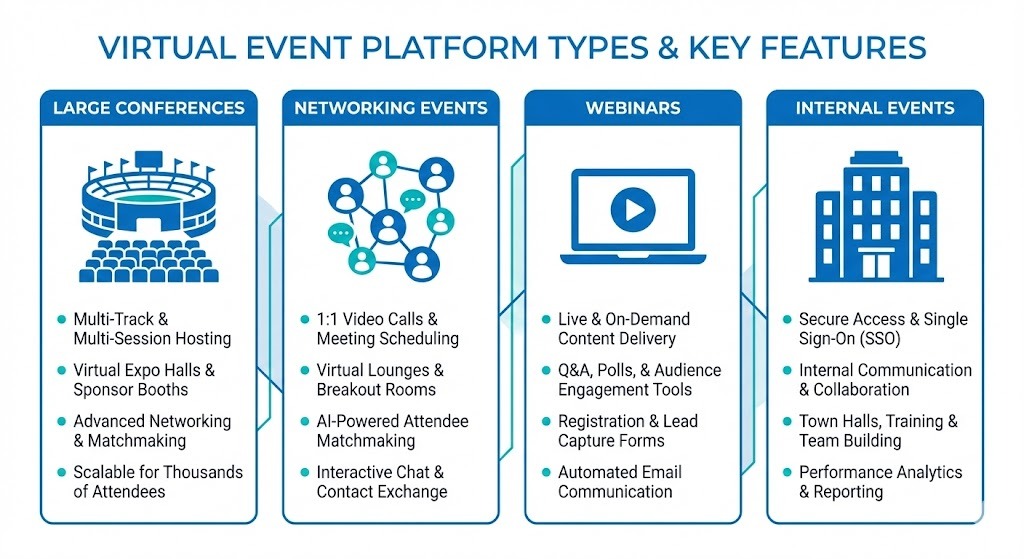
Hopin built its reputation on large conferences. Multiple stages, one-on-one networking, virtual expo halls. It’s feature-rich but can be overwhelming for simpler events. If you’re running something with 1,000+ attendees and need the full conference experience — main stage, breakout sessions, expo booths, networking — Hopin has the most complete feature set.
Airmeet is strong on community and networking features. The interface is more approachable, and they have solid India-based support. Good for events where connection matters more than scale. We’ve used Airmeet for events where the client’s primary goal was getting attendees to talk to each other — think industry meetups, community events, smaller conferences. Their “social lounge” feature actually works the way networking is supposed to work.
Zoom Events works well if your audience already knows Zoom. Familiar interface, reliable performance. Limited on the bells and whistles, but sometimes reliability matters more than features. Don’t underestimate the value of not having to explain how to join.
Hubilo focuses heavily on B2B events and lead generation. If your event is primarily about connecting exhibitors with attendees, they’ve built specifically for that. Their analytics around lead scoring and attendee engagement are genuinely useful for marketing teams trying to prove event ROI.
Microsoft Teams Live Events is the one nobody thinks about but probably should. If your organisation already runs on Microsoft 365, it’s essentially free and integrated into tools your people already use. The production capabilities are basic compared to dedicated event platforms, but for internal events and webinars, it’s surprisingly capable.
Zoho Backstage deserves a mention, especially for Indian companies already in the Zoho ecosystem. It’s built in India, priced for India, and the CRM integration with Zoho is seamless. It’s not as feature-rich as Hopin or Airmeet for large conferences, but for webinars and mid-sized events, the value proposition is hard to beat.
Pricing Realities
Let’s talk money, because the pricing pages on these platforms are deliberately vague. I’ll share what we’ve seen our clients actually pay.
Zoom Events starts around 6,000-7,000 INR per month for up to 500 attendees. That’s genuinely affordable, and the per-attendee cost drops as you scale.
Airmeet has a free tier for small events, which is great for testing. Paid plans start around 50,000-75,000 INR per month for professional features. For annual subscriptions, expect 4-6 lakhs per year.
Hopin pricing has changed multiple times, but current plans typically start around 8,000-10,000 INR per month for basic features. Enterprise plans for large conferences can run 8-15 lakhs annually.
Hubilo doesn’t publish pricing — everything is “contact sales.” In our experience, expect 5-12 lakhs per year for mid-sized deployments.
Microsoft Teams Live Events is included with Microsoft 365 E3/E5 licenses. If you’re already paying for Microsoft 365, this is essentially free.
Zoho Backstage is the most India-friendly on pricing. Plans start around 1,500-2,000 INR per month. Annual plans with full features run 50,000-1.5 lakhs per year.
One thing I’ll say: always negotiate. Platform vendors have significant margin on their pricing, and Indian companies have leverage because the market is growing fast.
What to Test Before Committing
Never choose a platform based solely on a sales demo. Demos show the platform at its best, with rehearsed flows and ideal conditions.
Ask for a trial environment. Invite colleagues to test as attendees. Try to break things. See what happens when internet is slow. Check the experience on mobile devices. Test the actual features you’ll need, not the impressive ones the salesperson wants to show you.
Here’s a testing checklist we use with clients:
Test on a 10 Mbps connection. Not your office fibre — tether your phone on 4G and see what happens. Many of your attendees will be on inconsistent connections.
Test on mobile. We’ve seen events where 40% of attendees joined from phones. If the mobile experience is poor, you’ve lost nearly half your audience.
Test the registration flow. Ask someone non-technical to register and join. Time them. If it takes more than three minutes from clicking the link to being in the event, it’s too complicated.
Test what happens when things go wrong. What if a speaker loses connection? What if the stream buffers? A good platform fails gracefully. A bad one panics your audience.
Integration Considerations
Platforms don’t exist in isolation. They need to talk to your other systems, and this is where many companies get caught out.
CRM integration is table stakes if you’re running B2B events. Attendee data should flow into Salesforce, HubSpot, or Zoho CRM automatically. Hubilo and ON24 are strongest here. Airmeet and Hopin have decent integrations but sometimes require middleware like Zapier.
Marketing automation matters if your events are part of a larger funnel. Can attendee behaviour — which sessions they attended, how long they stayed — trigger automated follow-up sequences?
Analytics and reporting vary wildly between platforms. Some give you basic attendance numbers. Others tell you exactly when people dropped off, which content resonated, and which attendees were most engaged. If proving event ROI matters to your leadership, dig deep into what analytics each platform actually provides.
Single sign-on (SSO) matters for internal corporate events. If your employees already have Microsoft or Google credentials, making them create yet another account creates friction.
Support Matters More Than You Think
Technical issues during a live event aren’t theoretical — they’re inevitable. What matters is how quickly they get resolved. Time zones matter here. A platform with India-based support will respond faster during Indian business hours than one headquartered in San Francisco.
Ask vendors specifically: if something goes wrong during our live event at 11 AM IST on a Tuesday, what happens? Who do we call? How fast will someone respond?
We’ve had situations where a platform went down mid-event and the only support channel was an email address with a 24-hour response time. That’s useless when you have a CEO on stage and 2,000 attendees waiting.
When You Don’t Need a Platform
Here’s something platform vendors definitely won’t tell you: sometimes you don’t need a dedicated event platform at all.
If your event is primarily a broadcast — a product launch, a keynote, a town hall where interaction is limited to Q&A — a well-produced live stream to YouTube Live or a private RTMP destination, combined with simple engagement tools, often works better than a full event platform.
We’ve done this for events with 10,000+ viewers. Professional multi-camera production, streamed to YouTube Live with a custom-branded landing page, Slido embedded for interaction. The production quality was better than any virtual event platform could deliver, and the client saved lakhs on platform fees.
The platforms are genuinely valuable when you need networking, breakout rooms, exhibition booths, or complex multi-track scheduling. For broadcast-style events with basic interaction, they’re often overkill.
The Platform Isn’t Everything
Here’s what vendors won’t tell you: the platform is maybe 30% of a successful virtual event. Production quality, content design, speaker preparation, audience engagement strategy — these matter more than which software you use.
We’ve seen terrible events on great platforms and excellent events on basic platforms. The platform is a tool. How you use it determines results.
Need Help Choosing?
We work with all major virtual event platforms and we’ve seen what works and what doesn’t across hundreds of events. Happy to share what we’ve learned about which platform works best for different types of events — no sales pitch, just honest advice based on experience.
Reach out: +91 96635 06306 or sales@thalsamaya.com.